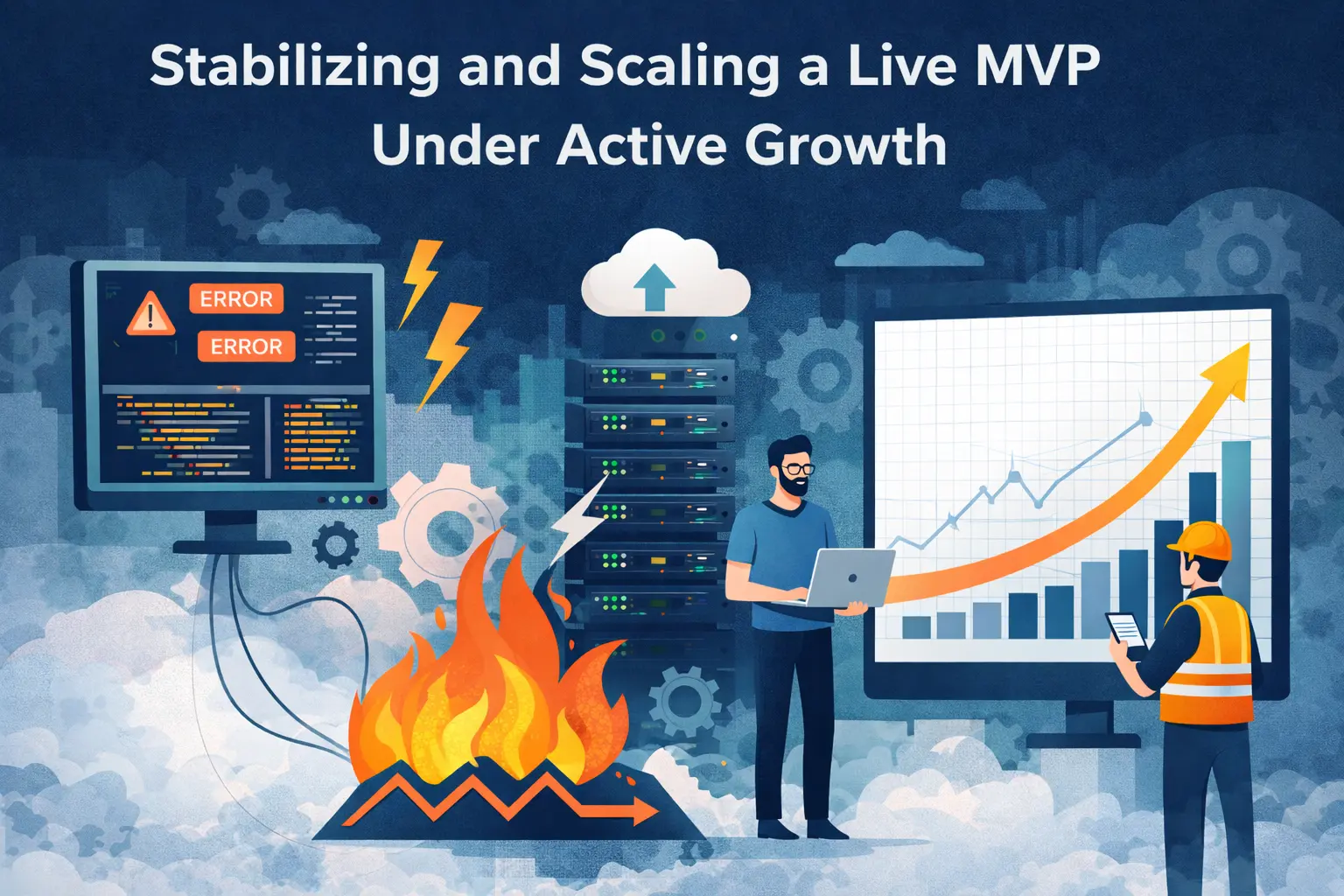
TL;DR
- Context: Technical co-founder at a pre-seed startup running a live social product under growth and fundraising pressure
- Problem: A fragile, single-instance backend created existential reliability and scalability risk
- Intervention: Incrementally re-architected critical paths and removed single points of failure without downtime
- Impact: Supported 5× user growth, stabilized performance, and passed investor technical scrutiny
Intro
This work was done as part of my full-time role as technical co-founder at a pre-seed startup with a live, real-time social application. The product had early traction, but the backend had not been designed for reliability or growth. Any significant outage during this phase would have directly impacted user trust and fundraising momentum, with no room for downtime or rewrites.
Problem
- The entire production stack ran on a single instance with no failover or backups
- Backend structure made changes risky and regressions hard to predict
- Performance degraded rapidly as usage increased, threatening retention
- A full rewrite was not viable due to active users and continuous feature delivery
Intervention
- Chose a phased stabilization approach over a rewrite to reduce risk
- Enforced forward-only architectural discipline while migrating legacy paths opportunistically
- Prioritized removal of single points of failure before scaling traffic
- Introduced deployment and operational guardrails to prevent regression
- Used observability to guide performance and reliability decisions
Impact
- Platform scaled from ~1,000 to 5,000+ users without critical outages
- Median response times dropped from seconds to sub-300ms
- System reliability improved enough to withstand investor technical diligence
- Feature delivery continued throughout with zero production downtime
Why This Matters
Early-stage systems often fail not because they lack features, but because they cannot absorb growth safely. Incremental architectural correction under real constraints compounds faster than rewrites—and preserves momentum when the business cannot afford disruption.
Technical Deep Dive (Optional)
This section expands on architectural decisions, execution details, and quantitative outcomes for readers who want technical depth.
View technical deep dive
Starting State (Baseline)
Architecture
- Monolithic Node.js backend deployed as a single process on one EC2 instance
- MongoDB running on the same instance as the application
- No separation between HTTP handling, business logic, and data access
- No CI/CD; deployments performed manually to production
Operational Risk
- Single point of failure across application, database, and networking
- No automated backups, replication, or recovery plan
- Any deployment or crash resulted in full platform downtime
Performance
- Median API response time: ~1–2s
- Home page load time: >10s at ~1,000 concurrent users
- APIs routinely returned unbounded datasets (rooms, messages, user lists)
Architectural Direction
Decision: Incremental re-architecture over rewrite.
Rationale
- A rewrite would halt feature delivery during active growth and fundraising
- Incremental changes allowed reversible decisions and continuous validation
Target Architecture
- Enforced a strict 4-layer separation:
- Validation layer – schema validation and early rejection
- Controller layer – HTTP concerns only
- Service layer – stateless domain logic
- Data access layer – centralized database interaction
Outcome
- ~90–95% of endpoints migrated over time
- Regression risk reduced as boundaries became explicit
Performance Optimization
Query & Response Strategy
- Introduced pagination (20–50 items per page) with hard limits
- Eliminated “load everything” access patterns on high-traffic endpoints
- Reduced payload sizes to return only required fields
Database
- Added indexes for frequently queried fields
- Refactored aggregation pipelines for predictable execution time
- Introduced slow-query logging and query-level monitoring
Caching
- Added Redis for read-heavy paths (rooms, user state, metadata)
- Reduced MongoDB read load by ~40–50% on critical endpoints
Measured Impact
- Median API response time: 1–2s → 200–300ms
- Home page load time: >10s → ~1–2s
- Performance remained stable under ~5× traffic growth
Infrastructure & Reliability
Immediate Risk Mitigation
- Migrated MongoDB to Atlas with automated backups and replication
- Decoupled database availability from application uptime
Application Layer
- Introduced multi-process execution (PM2) per instance
- Added health checks and basic load balancing
Long-Term Stability
- Dockerized the backend using multi-stage builds
- Migrated to AWS ECS with horizontal scaling and auto-scaling policies
- Implemented CI/CD with automated tests and deployments
- Added blue–green deployments with automated rollback
Operational Improvements
- Deployment time reduced from 30+ minutes → ~5 minutes
- Zero user-facing downtime during migration and scaling
Operating as a Solo Backend Owner
Scaling Personal Throughput
- Established architectural patterns to prevent regressions
- Created runbooks and documentation for operational clarity
- Added monitoring and alerts to surface issues early
Decision Support
- Used APM and logs to diagnose performance issues offline
- Avoided live experimentation in production under load
- Let data, not intuition, guide optimization priorities
Final System Characteristics
- Horizontally scalable backend with no single points of failure
- Predictable performance under load
- Deployment and recovery processes independent of tribal knowledge
- Architecture that new engineers could reason about without implicit context
Work completed over ~8 months while maintaining zero production downtime and supporting company growth from pre–pre-seed to pre-seed stage.